I feel like this unit has opened up more opportunities for me to explore technological resources that would enhance learning, including language learning. I think that we are moving beyond the traditional classroom or the traditional way of teaching is definitely a trend that I see in many classrooms, with many learners choosing online learning or blended learning for classes. The increased accessibility and flexibility of online or blended learning has given learners a chance to learn language despite having personal challenges, such as childcare or transportation issues. I have met many people who are genuinely interested in learning, but does not have the necessary support or resources to be able to engage in a traditional classroom. I think that the most challenging aspect of being an immigrant or a refugee that has lower language skills is that they need to work right away, but do not have the necessary language or financial supports that would enable them to secure a job. Some even have literacy issues that make it more challenging to learn.
I would like to incorporate infographics, games, applications, audios and videos that would help enhance learning, and this plays on the principles of adult learning. Engaging as much of the senses will help learners absorb or remember information. Keeping the learners engaged in the content also involves giving them content that is readily applied, which is the bulk of what I do within the classroom since it is occupational-specific training.
Looking back at my lesson plan, the vocabulary exercise is something that could be turned into a video or a game -- with it being interactive and engaging, and may utilize a competitive situation among learners. Therefore, instead of using a quiz, I could possibly use the "Space Race" function on Socrative and have it as a group activity, which requires learners to work together but have a competitive spirit in the activity. The engaging activity can aid in remembering information or storing information in our long-term memory.
I believe that in order for us to enhance the learning experience of students and assist in the acquisition of digital literacy (which is required for many tasks today), which may be incorporated within the visible or hidden curriculum. The use of videos and other interactive materials may enhance learning, and making it readily available or accessible outside of the classroom environment. By making it readily accessible for learners outside the classroom setting, they can practice and further develop their language skills.
Therefore, I do think that we can explore more programs that can help us enhance learning within or outside of our classrooms. Due to the restrictions that were placed on me since I work for a non-profit organization, I do intend to look for free programs or applications that I can use to incorporate into my lesson plans so that I can properly assess skills or present information to the class.
Showing posts with label unit posts. Show all posts
Showing posts with label unit posts. Show all posts
Saturday, 10 November 2018

Unit 8 Blog Post
Going through the unit, I realized that daily assessment and feedback is essential in language learning. Immediately giving learners feedback is essential to their learning process and it helps me look at the content to see what I can improve to help them efficiently move forward through topics. Assessments should be done before, during and after the topics, and somehow I only do so before and after the topic. Continuous assessment is important when it comes to learning, because the learners start to understand what they are doing well and what they need to improve on.
Going back to my original feedback, I would change it to the following:
When it comes to providing feedback, one thing that I did realize going through this unit is that I am somewhat ineffective when it comes to providing specific feedback because I do use the sandwich method. However, the feedback that I give are not specific. For example, I would say, "I really think you have a good attitude and I like your effort. However, you need to improve your listening skills and really listen to the information I give you. I do think you are working really hard, and this is something that you can improve so that you can become better." Now, I realize that this is not quite helpful when it comes to actually encouraging learners to improve their skills, because I don't give them specifics of what exactly they are doing well, what they should continue to do, and what they need to do more.
I thought the action-oriented feedback was a really helpful topic, and I love the fact that there were exemplars and a table to simplify the process for instructors. I copied the table below (https://www.youtube.com/watch?v=NDbkhsNfmK4)
I thought the action-oriented feedback was a really helpful topic, and I love the fact that there were exemplars and a table to simplify the process for instructors. I copied the table below (https://www.youtube.com/watch?v=NDbkhsNfmK4)
Comment on aspects of performance that were effective. Be specific and describe the impact. Highlight things that you would like to see done in the future
|
|
Going back to my original feedback, I would change it to the following:
"I think you should continue to use keywords and use them in your response when speaking to another person. I would like to see that you continue to use related words (similar words) in place of keywords in the future, since this will help you gain more vocabulary. Consider listening to the radio for discussions or questions, and give meaningful responses to the questions by the use of keywords and related words. One thing that i would like you to do less is responding before the other person is finished speaking. This is not good because you don't know all the information that they are trying to give you and it may come across as not appropriate in the conversation. You may respond with something that is not really related to what they are talking about, or you might ask a question that they would be talking about anyway."
The other aspect of the unit is on assessment tools, and I really want to explore this a bit more in my classroom. We currently have action plans, checklists, learning logs, quizzes, and records of observations. However, I would like to see self-observation be included, since it would be the record of learning through the perspective of the learner. They would be able to write down observations that they have regarding their skills and capabilities. I would like to implement this when there is a significant challenge or exercise that we do in the class, to practice self-awareness as as skill but to also have information on what they think they are doing well and what they need to improve.
The other aspect of the unit is on assessment tools, and I really want to explore this a bit more in my classroom. We currently have action plans, checklists, learning logs, quizzes, and records of observations. However, I would like to see self-observation be included, since it would be the record of learning through the perspective of the learner. They would be able to write down observations that they have regarding their skills and capabilities. I would like to implement this when there is a significant challenge or exercise that we do in the class, to practice self-awareness as as skill but to also have information on what they think they are doing well and what they need to improve.
Unit 7 Blog Post
I really enjoyed this unit, as it made me think about scenarios that many language teachers or instructions handle. I have had some challenging classroom situations, but it was enlightening to see other issues as well. Perhaps what is unique about my classroom is that it is employment-oriented, which means that they would have the same expectations in the classroom as at work. It is perhaps easier to address certain problems, such as being late or attendance issues or attitude issues, when we tie it to the workplace culture and expectations of their current employer. They are also under the guidance of an employment coach, and problems are usually handled by the employment coach when it escalates. Perhaps what makes this topic interesting is that most scenarios are rooted from the learners' personal challenges or background, and at times, these could include trauma or PTSD (from my experience). Two things that really benefited me in my position is the Helping Model and Motivational Interviewing, which can be used to help learners think about their challenging behaviours in a logical way and then help them make a plan for change. I believe that the Helping Model and Motivational Interviewing enables myself to connect with my participants and help them through challenging situations or behaviours by giving them the tools or insight as to how the situation can affect them in the future. In addition, it gives me some insight as to their background, culture, learning considerations and personal challenges.
I have picked one scenario that I really wanted to analyze, as I have not yet encountered it and would like to give myself some space to think about how to manage it within the classroom.
Scenario: A small group of learners tend to dominate class discussions and correct others. You also notice that other learners are becoming more and more disengaged... How would you address this situation?
How I would handle the situation: I would try to first address the problem with the whole class, and let all learners know that I expect everyone to participate in class discussions and only give feedback when we have activities that require us to do so. If it continues, I would talk to the small group of learners on a one-on-one basis, ask them how they are doing, and then give them some feedback in regards to how to improve in the classroom and classroom etiquette. I would also praise them for being a leader, but leading also means letting others have a chance, much like at work. I would then check in with them once in a while to see how they feel and how they are doing. I would also incorporate activities that let participants write down their own thoughts first and then have them share in groups, emphasizing that they would need to listen to each other's answers so that they report it back to the whole class.
Speaking of grouping, I have also completed the table with the advantages and disadvantages
I have picked one scenario that I really wanted to analyze, as I have not yet encountered it and would like to give myself some space to think about how to manage it within the classroom.
Scenario: A small group of learners tend to dominate class discussions and correct others. You also notice that other learners are becoming more and more disengaged... How would you address this situation?
How I would handle the situation: I would try to first address the problem with the whole class, and let all learners know that I expect everyone to participate in class discussions and only give feedback when we have activities that require us to do so. If it continues, I would talk to the small group of learners on a one-on-one basis, ask them how they are doing, and then give them some feedback in regards to how to improve in the classroom and classroom etiquette. I would also praise them for being a leader, but leading also means letting others have a chance, much like at work. I would then check in with them once in a while to see how they feel and how they are doing. I would also incorporate activities that let participants write down their own thoughts first and then have them share in groups, emphasizing that they would need to listen to each other's answers so that they report it back to the whole class.
Speaking of grouping, I have also completed the table with the advantages and disadvantages
|
Grouping
|
Advantages
|
Disadvantages
|
|
Learners are grouped by classroom proximity
|
Very easy to organize
|
Groups may be the same throughout the term, as learners tend to sit
in the same places
|
|
Same level ability groups
|
Easy to address challenges, and can give feedback based on level
|
Groups with lower ability may not be able to improve a lot with the
exercise, as they may become more hesitant when seeing other groups
excel. They may also struggle a lot
more and would need more guidance and time than other groups – time may
become an issue.
|
|
Mixed level ability groups
|
|
|
|
Same language background groups
|
|
|
|
Mixed language background groups
|
|
|
|
Similar personality groups
|
|
|
|
Mixed personality groups
|
|
|
|
Random counting
|
|
|
Wednesday, 10 October 2018
Needs Assessment for Employment Partnership Program Language Learners
Needs Assessment for Adult Learners Engaging in my Workshops:
Where: Performed by the student during the first impressions meeting with the designated Employment Coach, which they will submit by the end of the meeting
When: The learner will fill out the form after the registration process and before attending Work Exposure, which includes a tour of the factory and a skill assessment
How: Using a variety of survey questions, which is kept concentrated on work as the program is specifically targets employment


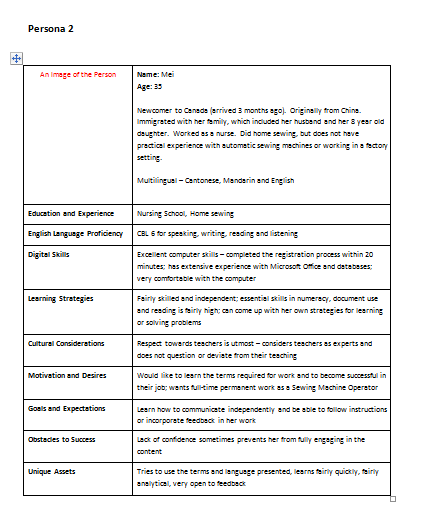
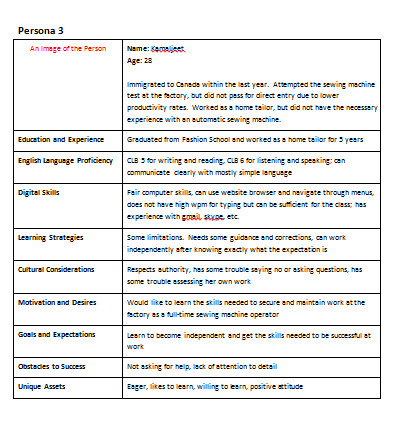

Where: Performed by the student during the first impressions meeting with the designated Employment Coach, which they will submit by the end of the meeting
When: The learner will fill out the form after the registration process and before attending Work Exposure, which includes a tour of the factory and a skill assessment
How: Using a variety of survey questions, which is kept concentrated on work as the program is specifically targets employment
Image 1 and 2: 2-page needs assessment for the class
Image 2: Sample self-assessment learning profile (mine)
Image 3, 4 and 5: Assessment of Learning Profile
Subscribe to:
Posts (Atom)