Perhaps what I have learned going through the unit is that I am a bit more lenient regarding grammatical rules, and that the minimum grammatical structure is enough for the purpose of the training that I conduct with the learners (essential skills training for Sewing Machine Operators). I believe that getting caught up on the fine rules and concepts when it comes to grammar just makes it more difficult for English learners to communicate and become more comfortable with their pronunciation. One of the barriers that I often notice with my learners is the lack of self-confidence. The lack of self-confidence often leads them to conclude that "[their] English is not good." The sentence would often be repeated many times because learners are not confident with their ability to communicate despite being able to form sentences that are coherent and can be understood. When language learners do not build up their confidence, they often become shy and resistant to engaging in conversations with others (especially those with higher language skills). This is often a problem in the workplace, since they would need to communicate with a wide range of people (supervisors, co-workers, etc.). Therefore, may be understood and studied to the point wherein it can assist the learner in putting together coherent sentences that could facilitate effective communication.
Perhaps one of the biggest topics that I could foresee as being important would be verb tenses, adjectives, and the use of nouns (possessive, etc.). Since I am considering the topic of employment (which is my lens of understanding), I would be concentrating on grammatical structures that may be essential when communicating with the learners (and vice versa). Being able to describe the type of help that they need, or what they have done or want to do so far, and what they know is fairly important when discussing their employment development plan or training. These grammatical structures are also fairly important when it comes to communicating in the workplace, since they would need to describe products or difficulties they may have while working, any clarification regarding the work, or what they have done or what they need to do during the work day. It is important to understand the basics of grammar to form sentences, but more advanced points of grammar (adverbials, etc.) would not be necessary for the language learner to know in order to be able to communicate verbally or in written form.
I think that I would be more cognizant of grammar and its overall role in language development and pattern recognition (grammatical rules and exceptions), but I would also remind myself that not knowing more advanced grammatical points would not prevent the language user to effectively communicate.
Thursday, 25 October 2018

Unit 3: Teaching Grammar
Teaching grammar, especially when handling a class with a wide range of levels and needs, may be challenging. It is important to have a variety of materials prepared, but not get caught up with the terms used (adjectives, adverbs, nouns, pronouns). We should be able to present these terms and explain what they are, but at the minimum level required to use them. Since these are basic parts of English grammar, most languages would also have some version of these grammatical components, and it is possible that they connect these concepts together.
For example, in the Tagalog language, pronouns and nouns are "pangalan" while adjectives are closely related to "pang-uri." By having knowledge of these basic grammatical components, it would be easy to understand the concept, but also apply it in writing, reading, speaking and listening. Understanding minimal grammatical components helps them organize words, understand how to describe nouns or emphasize certain adjectives or nouns using adverbs. Since speech often follow basic grammar, it would be easier for the learner to understand the meaning of sentences or even their general idea.
I prepared some sample slides, with the basic discussion of nouns and some questions regarding nouns.


I would like to develop more instructional materials regarding grammar, and found some websites that may be able to help.
More information about me... as a learner and educator
You can view my ABOUT ME me page for a summary!
Perhaps the most interesting about me is my history. My unique history has led me to a path of an educator. I graduated with a B.Sc. (Hons) in Psychology and a double minor in Microbiology and Biological Sciences. I did my honours thesis in area of Applied Behavioural Sciences, which enabled me to assess preference in individuals with developmental and intellectual disabilities. I also finished an independent thesis in the area of Neuroscience, which observed the effects of enriched environment on rat models of autism. From there, I worked as an Autism tutor. I worked with different children with varying levels of functioning.
From there I was fortunate to attain a position as an Administrator for Opportunities for Employment, which is an employment services organization. I eventually moved into a facilitator role. I took classes in Behavioural Facilitation and eventually acquired a Certificate in Adult and Continuing Education (CACE). I also started my Human Resources Management Diploma with Red River College, Curriculum Development and Instructional Design Extension Certificate with Mount Royal University, a Masters of Education with University of New Brunswick, and a Teaching English as a Second Language program with University of Manitoba.
All of the training and education that I am pursuing is due to the increasing education and language training demands within our community and my organization. The increased influx of refugees and immigration, and the demand for programs that support their transition into Canada, has increased the demand for certain frame of thinking that could support their learning and training. Due to this, I have decided to pursue further training that would enable me to better serve my participants and understand their needs a bit more. I would like to become more effective in designing and delivering training programs and instructional materials that language learners can engage in and retain so that they may be successful in their job search and technical training.
I am passionate about giving people the help that they need so that they can bridge the gap between who they are right now and the successful version of themselves.
Perhaps the most interesting about me is my history. My unique history has led me to a path of an educator. I graduated with a B.Sc. (Hons) in Psychology and a double minor in Microbiology and Biological Sciences. I did my honours thesis in area of Applied Behavioural Sciences, which enabled me to assess preference in individuals with developmental and intellectual disabilities. I also finished an independent thesis in the area of Neuroscience, which observed the effects of enriched environment on rat models of autism. From there, I worked as an Autism tutor. I worked with different children with varying levels of functioning.
From there I was fortunate to attain a position as an Administrator for Opportunities for Employment, which is an employment services organization. I eventually moved into a facilitator role. I took classes in Behavioural Facilitation and eventually acquired a Certificate in Adult and Continuing Education (CACE). I also started my Human Resources Management Diploma with Red River College, Curriculum Development and Instructional Design Extension Certificate with Mount Royal University, a Masters of Education with University of New Brunswick, and a Teaching English as a Second Language program with University of Manitoba.
All of the training and education that I am pursuing is due to the increasing education and language training demands within our community and my organization. The increased influx of refugees and immigration, and the demand for programs that support their transition into Canada, has increased the demand for certain frame of thinking that could support their learning and training. Due to this, I have decided to pursue further training that would enable me to better serve my participants and understand their needs a bit more. I would like to become more effective in designing and delivering training programs and instructional materials that language learners can engage in and retain so that they may be successful in their job search and technical training.
I am passionate about giving people the help that they need so that they can bridge the gap between who they are right now and the successful version of themselves.
Friday, 12 October 2018
Blog Post: Who are my learners
Learning about learners is something that is emphasized in our work as teachers or educators in theory, but it is something that we may not have as priority due to the tremendous amount of work that we face. However, it is important to note that getting to know our learners would not only increase the their engagement in the content or class and lessons become more readily applicable. By knowing our learners, we can tailor instructions and prepare materials that address their needs and concerns. By doing so, educators can efficiently teach a topic or material and effectively address language issues existing in each class. Needs assessments can also bring insight to the barriers that learners face, and it prepares educators to handle these issues. Educators can prepare resources or compile a set of resources, and give the appropriate structure or materials that can assist learners that do deal with a wide range of barriers.
For example, I have dealt with participants who have challenges with childcare. I have often provided them with a list of places that they can go to for help, and included information about childcare subsidies. Another example would be those with transportation issues. I often suggested carpooling and accessing some transportation supports from different non-profit programs.
What I would like to do moving forward is performing a needs assessment before the start of classes -- since my classes are about 2 weeks long. By doing so, I can get a chance to get to know the learners before they step into the classroom, and then prepare or alter parts of the materials with the expressed needs of the learners. Of course, the classes are still focused on employment, so I would have to balance their interest with that project deliverables (what we promised to funding organizations or government departments).
For example, I have dealt with participants who have challenges with childcare. I have often provided them with a list of places that they can go to for help, and included information about childcare subsidies. Another example would be those with transportation issues. I often suggested carpooling and accessing some transportation supports from different non-profit programs.
What I would like to do moving forward is performing a needs assessment before the start of classes -- since my classes are about 2 weeks long. By doing so, I can get a chance to get to know the learners before they step into the classroom, and then prepare or alter parts of the materials with the expressed needs of the learners. Of course, the classes are still focused on employment, so I would have to balance their interest with that project deliverables (what we promised to funding organizations or government departments).
Thursday, 11 October 2018
Blog Post: Unit 1 Who Am I
The most memorable teacher that I had so far was my behavioural facilitation instructor, who focused on the students' needs and how it aligns with the curriculum than the other way around. He created a safe environment through various small and meaningful activities that help progress the discussion and practice specific skills. It is important to note that the instructor made sure to create a fostering and sage environment by having students interact in pairs, small groups and only then challenge them to perform a skill in a group setting. He also made it easier to practice skills through giving examples that students can use as a template or as a starting point to generate other ideas.
As a facilitator of occupation-specific essential skills and employability skills, I aspire to become a teacher that can efficiently deliver curriculum for individuals with a wide range of barriers (including language barriers). I would like to be better at creating a safe environment for English language learners, and help them increase their chances of finding employment and keeping them. Perhaps the most challenging aspect of my job is to find ways to teach learners with low language benchmarks the appropriate behaviours, skills and attitudes for work. The learners must be able to understand instructions and feedback in order to pass technical training and acquire employment, and continuously incorporate feedback in order to maintain work and transition over to piecework.
Perhaps the most important skill or attribute that I would like to practice is the ability to create activities or materials that learners can immediately connect with and is effective in imparting important information regarding the workplace. Tailoring is a related skill that is important in this process, and it is essential that me (as a teacher) to ensure that materials and activities are tailored towards the knowledge or skill gaps and interest of the learners. I believe that I am creative and flexible enough to create materials that would help learners, but I aspire to become a teacher that has a good understanding of what the student exactly needs to learn the content. I am motivated to become efficient at what I do, and aware that there are many ways to address learning issues and each situation would need to have a unique approach.
As a facilitator of occupation-specific essential skills and employability skills, I aspire to become a teacher that can efficiently deliver curriculum for individuals with a wide range of barriers (including language barriers). I would like to be better at creating a safe environment for English language learners, and help them increase their chances of finding employment and keeping them. Perhaps the most challenging aspect of my job is to find ways to teach learners with low language benchmarks the appropriate behaviours, skills and attitudes for work. The learners must be able to understand instructions and feedback in order to pass technical training and acquire employment, and continuously incorporate feedback in order to maintain work and transition over to piecework.
Perhaps the most important skill or attribute that I would like to practice is the ability to create activities or materials that learners can immediately connect with and is effective in imparting important information regarding the workplace. Tailoring is a related skill that is important in this process, and it is essential that me (as a teacher) to ensure that materials and activities are tailored towards the knowledge or skill gaps and interest of the learners. I believe that I am creative and flexible enough to create materials that would help learners, but I aspire to become a teacher that has a good understanding of what the student exactly needs to learn the content. I am motivated to become efficient at what I do, and aware that there are many ways to address learning issues and each situation would need to have a unique approach.
Wednesday, 10 October 2018
Needs Assessment for Employment Partnership Program Language Learners
Needs Assessment for Adult Learners Engaging in my Workshops:
Where: Performed by the student during the first impressions meeting with the designated Employment Coach, which they will submit by the end of the meeting
When: The learner will fill out the form after the registration process and before attending Work Exposure, which includes a tour of the factory and a skill assessment
How: Using a variety of survey questions, which is kept concentrated on work as the program is specifically targets employment


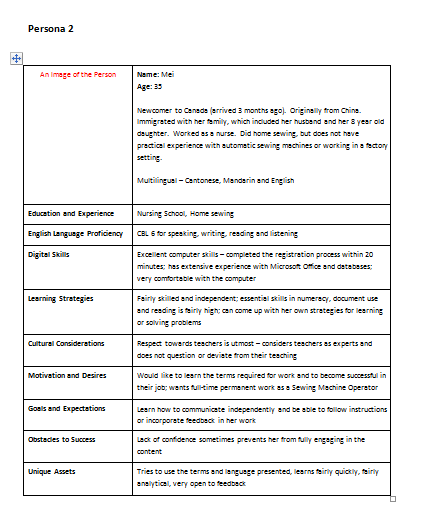
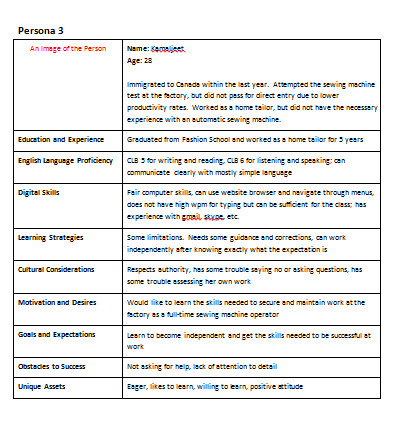

Where: Performed by the student during the first impressions meeting with the designated Employment Coach, which they will submit by the end of the meeting
When: The learner will fill out the form after the registration process and before attending Work Exposure, which includes a tour of the factory and a skill assessment
How: Using a variety of survey questions, which is kept concentrated on work as the program is specifically targets employment
Image 1 and 2: 2-page needs assessment for the class
Image 2: Sample self-assessment learning profile (mine)
Image 3, 4 and 5: Assessment of Learning Profile
Sunday, 4 February 2018
Assignment 3: Self-Evaluation
My Learning Plan


1st GOAL
|
2nd GOAL
|
|
My goal for this course
|
Learn how I can incorporate assessment strategies into the
existing curriculum in order to improve the quality of workshops and
participant experience
|
Learn how to differentiate assessments, evaluations, and
testing, and appropriately select one to apply in particular circumstances
within the curriculum
|
How I’m going to achieve it
|
Reading through the course materials, connecting with
other professionals and learners within the field, discussing it in forums
and other social media platforms
|
Reading through the course and discussing it with my
peers; getting guidance from other learners and the instructions through
discussion points
|
How will I know that I have achieved it
|
Drafting assessment strategies that best fit the given
circumstance and implementing it in the classroom setting to see how well it
measures performance
|
Being able to thoroughly differentiate the concepts and
terms. Application questions and discussions will be relatively easy to
engage in if I am able to differentiate amongst them
|
How I will demonstrate what I have learned
|
Incorporating and applying different assessment strategies
to different learning situations to give a complete picture of performance
and to analyze performance issues
|
Choosing the right term and idea when selecting one to
apply in particular circumstances within the given curriculum, in order to
further improve the curriculum and the learner experience
|
Notes
|
Reflecting and researching are important aspects of this
particular goal
|
Researching and reading are going to be important with
this particular goal; applying it in the classroom would increase
understanding
|
When I revisited my learning plan and the goals that I have set for myself during the first week of the class, I started to compare the body of knowledge that I had before the class and afterwards. It surprised me how amazing this journey has been for me and the depth of knowledge that I have developed when it comes to assessing learning within the classroom. Although it was difficult to juggle all the tasks with my other responsibilities, it was really refreshing to see how my perspective has changed.
I registered for the program in order to enhance my understanding towards participants with low language benchmarks, and really understand how I can effectively provide the best training that I can in order to increase their success in employment and job retention. I went into the course without any formal training in ESL, but with a strong background in instructional design and facilitation. That being said, I was determined to tailor my employability skills workshop towards my ESL participants. When I saw that the Assessment and Evaluation course for TESL was available, I thought it would be a great opportunity to expand my knowledge on conducting and creating materials for assessments and evaluations within the classroom. I wanted to really see the difference between assessment, evaluation, and testing in the ESL context, and incorporate assessment strategies into our existing curriculum. As I reflect on my learning, as this is my first class for the TESL program, I realized that I had a limited knowledge regarding the complexity of assessments. I have taken classes on design and assessment strategies, but I lacked the understanding of the differences in purpose of formative or summative, and informal or formal assessments. We often take for granted that we can use classroom assessment techniques (CAT), but we often lack the understanding of WHY we use certain CATs in certain points or ways. After the course, I really took it to heart that it is important to have both summative and formative assessments -- formative to guide learning and summative to measure learning at the end of the workshop -- and to make use of the latter to prepare for the other. In this course, I learned to really pay attention to informal assessments, as they give the opportunity to measure the learners' performance on a realistic level (without added pressure of a formal assessment).
Understanding the purpose of each assessment really enhances my ability to facilitate classes that do have participants with low language levels. The course has increased my ability to assess their understanding of the content, expectations, and performance feedback. One thing that I actually started to think more about is the assessment that I use, and how I can assess the tools that I have been using and want to use in the classroom. For example, I have started to develop an assessment tool that involves a real-life video scenario of an employment coach providing feedback to a participant. The learner would be required to listen to the material and answer questions regarding the video. This assessment activity was inspired by the materials that were shared within the course. Interestingly, when I proposed this particular activity, the employment coach was thrilled that they can get the training needed to be able to pick out key details that can enhance their performance in training and at work. This is based on Mission 2 task for Unit 3 (http://learnenglishteens.britishcouncil.org/skills/listening-skills-practice/online-safety-conversation).
I tried to make sure that I followed my learning plan as closely as possibly, with completion of readings and activities. I tried to share my ideas as much as possible and learned from my peers through feedback and discussion. I also tried to make sure to explore as many additional resources as possible, so that I could deepen my understanding of the topics in the TESL point-of-view. Overall, I thought that I have accomplished my learning plan and I thought that it enhanced my understanding of how to tailor the classes to a more ESL-friendly one. One thing that I would like to do in the future is to further my understanding of the CLB levels and competencies, and how to draft multi-level rubrics. I thought that this part was quite interesting, and being able to create a rubric based on a lesson plan is quite interesting. I paid particular attention to some tools provided in tulela (https://listn.tutela.ca/resources/linc-assessment/writing-tools.html).

In my workshops, I was not given the opportunity to explore the application of a rubric, since it is employment training rather than essential skills training. I would love to create rubrics for assessments in the classroom so that I am given the chance to provide individualized feedback and enhance my learner's chance for employment and job retention. In the future, I would like to network with other professionals in the field -- I found that due to unforseen circumstances and heavy course load (I am still taking classes in Mount Royal University, University of New Brunswick, and Red River College on top of my TESL class), I was not able to do this as much as I wanted to. That being said, this is my first class in the TESL program and I look forward to more learning in the future.
References
British Council (2016). Online safety conversation. Retrieved
from: http://learnenglishteens.britishcouncil.org/skills/listening-skills-practice/online-safety-
conversation
from: http://learnenglishteens.britishcouncil.org/skills/listening-skills-practice/online-safety-
conversation
Citizenship and Immigration Canada, LISTN. (2015) Classroom Assessment Toolkit: Literacy to CLB 8. Retrieved from: https://listn.tutela.ca/resources/linc-assessment/classroom-assessment-
toolkit.html
toolkit.html
Webb, S. (2017, April) Creating Effective Rubrics. Powerpoint presented at TESL Peel Halton
Etobicoke Conference, 2017, Mississauga, ON. Retrieved from
https://www.teslphe.org/uploads/1/5/1/6/15162416/rubrics_pres_swebb_tesl_phe_2017.pdf
Etobicoke Conference, 2017, Mississauga, ON. Retrieved from
https://www.teslphe.org/uploads/1/5/1/6/15162416/rubrics_pres_swebb_tesl_phe_2017.pdf
Subscribe to:
Posts (Atom)